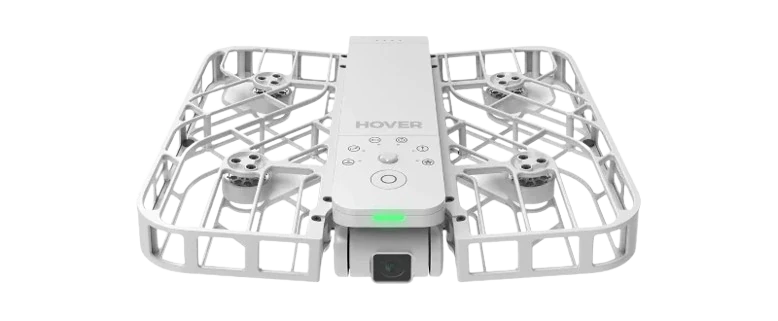
The HOVERAir X1 is a 125 g self-flying selfie drone built around a fully enclosed propeller cage and palm-launch tracking. It is not a long-range camera drone, it is the easiest way to get a smooth aerial shot of yourself running, biking or hiking, with zero controller experience and almost zero risk to people around you.
The HOVERAir X1 reframes what an entry-level drone can be. Instead of chasing camera specs and transmission range, Zero Zero Robotics built a 125 g flying camera that takes off from your palm, follows you through pre-set patterns and lands back in your hand, all without a controller, GPS lock or pilot certificate in most regions. The fully enclosed propeller cage is the biggest differentiator: you can hand-launch it indoors, fly it above kids or pets, and recover it mid-air without bracing for blade contact. For action sports, vlogging and travel selfies, it is closer to a GoPro accessory than to a traditional camera drone.
The X1 uses a 1/2.3-inch CMOS sensor with an f/2.4 lens and a 90° field of view, recording up to 2.7K at 30 fps and 12 MP stills. In bright daylight the footage looks clean and well-stabilised thanks to the 2-axis mechanical gimbal plus electronic stabilisation, and the wide-but-not-fisheye lens flatters faces from a few metres away. Dynamic range and low-light performance are clearly behind a Mini-class drone, however, so do not expect golden-hour magic, this is firmly a daytime social-content tool.
Flight time tops out at about 11 minutes per 1050 mAh battery, with a max speed of 6.7 m/s and wind resistance rated at Beaufort level 4. Transmission distance is limited (around 30 m) because the X1 does not use traditional video downlink as its main control loop, instead it locks on to its subject with vision-based tracking. In real use that means you almost always fly it at close range, like a cinematographer who happens to weigh nothing, rather than sending it to the horizon.
The X1 ships with a tight set of preset modes: Hover, Follow, Zoom Out, Orbit, Bird's Eye and Manual. You select one with a side button, the drone reads its surroundings using vision-inertial odometry (VIO) and executes the move autonomously. There is no GNSS, so it relies on visual texture to hold position, which is excellent in interesting outdoor scenes and weaker over flat snow or open water. The propeller cage doubles as a damper if you walk into a wall, making it the most forgiving drone we have ever recommended for total beginners.
The X1 and a DJI Mini 4 Pro compete for the same buyer's wallet but solve very different problems:
If you want hands-free shots of yourself, the X1 is unbeatable. If you want sweeping landscapes and 4K B-roll, save up for a Mini.
In the United States, the X1 sits well under the 250 g threshold at 125 g, so recreational pilots do not need to register it with the FAA. Commercial use under Part 107 still requires a Remote Pilot Certificate regardless of weight, and Remote ID rules apply to flights in regulated airspace. Always check local rules before flying, particularly around airports, stadiums and national parks.
The HOVERAir X1 is the right pick for runners, climbers, surfers and skiers who want a hands-free aerial GoPro, vloggers who hate juggling sticks and a phone, and parents who want a drone they can let kids near. It is also a great gift drone because the learning curve is essentially zero. It is the wrong pick for landscape photographers, FPV pilots and anyone who wants to fly far. For a more capable mini, see our best beginner drone roundup.
The HOVERAir X1 is the most innovative selfie-drone form factor on the market and the easiest aerial camera we have ever handed to a non-pilot. Image quality and flight time keep it from replacing a real camera drone, but for the niche it targets, hands-free social content with maximum safety, it is genuinely class-leading. Buy the Combo with extra batteries on day one.
No. The HOVERAir X1 is designed for controller-free use. You select a flight mode on the drone itself (Hover, Follow, Zoom Out, Orbit and others), launch from your palm and let it complete the shot autonomously. A phone app is available for previews and settings, but is not required to fly.
The propellers are fully enclosed inside a lightweight protective cage, so the X1 is one of the safest consumer drones to fly close to faces, hands and pets. The 125 g take-off weight also keeps impact energy low if it does brush against something.
Flight time is rated at about 11 minutes per 1050 mAh battery. In real-world tracking flights with wind and quick repositioning, plan on roughly 8 to 10 useful minutes per pack, so a spare battery is highly recommended.
For purely recreational flight in the US no FAA registration is required because the X1 is well under the 250 g threshold (it weighs 125 g). Commercial flights still need a Part 107 certificate, and Remote ID rules apply when flying in regulated airspace.
The X1 is a tracking selfie drone, not a long-range camera drone. A DJI Mini line drone has a longer transmission range, a 3-axis gimbal, longer flight time and better low-light performance. The X1 wins on portability, safety around people, and how quickly it gets a usable shot of you in motion.
It is rated for Beaufort level 4 wind (about 5.5 to 7.9 m/s). At its 125 g weight it is more wind-sensitive than heavier sub-250 g drones, so use it cautiously near beaches, ridgelines or open fields.
| Name | HOVERAir X1 |
| Gimbal | 2-axis |
| Image Sensor | 1/2.3-inch CMOS |
| FOV | 90° |
| Effective Pixels | 12 MP |
| Equivalent Focal Length | 19 mm |
| Aperture | f/2.4 |
| Video Resolution | 2.7K/30fps |
 | |
| Sensor size | 1/2.3-inch CMOS |
| Weight | 125g / 4.4oz |
| Width | 145mm / 5.7-inch |
| Release date | 2023-12-01 |
| Drone Price | USD 450 to 659 |
| Battery | 1050 mAh |
| Max Transmission Distance | 0.03 km (0.02 mi) |
| Wind Speed Resistance | Level 4 |
| Flight Time | 11 min. |
| Max Speed | 6.7 m/s |
| GNSS | only VIO |
| Features | Follow-Me |