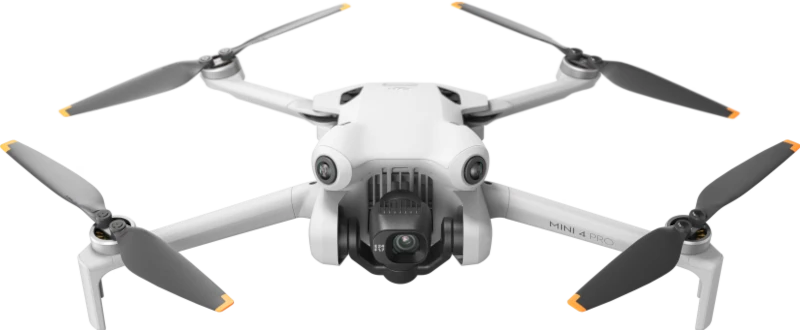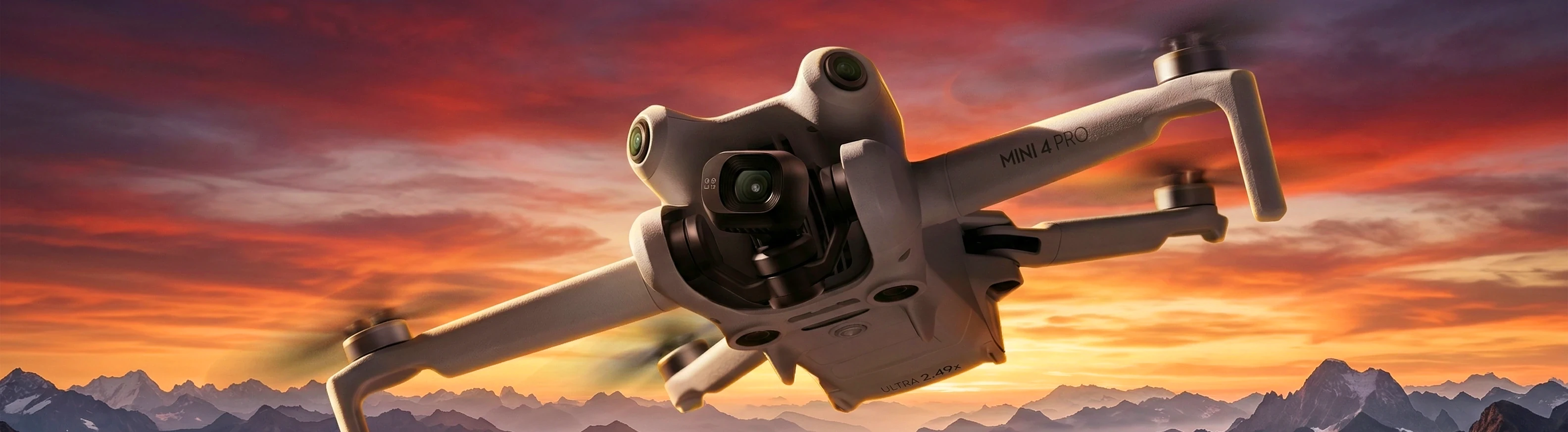
The DJI Mini 4 Pro packs omnidirectional obstacle sensing, ActiveTrack 360 and OcuSync 4 transmission to 10 km into a 249 g airframe with 4K/60 fps HDR video. With the Mini 5 Pro now at the top of the line-up, the Mini 4 Pro becomes the value sub-250g flagship in 2026, the smartest pick for travel creators who do not need a 1-inch sensor.
The DJI Mini 4 Pro was the first sub-250 g drone to add true omnidirectional obstacle sensing, and that single change shifted what a mini drone could do. Lateral and upward sensors give it the safety net previously reserved for Mavic-class airframes, while ActiveTrack 360 uses those sensors for confident subject following in environments where the Mini 3 Pro would refuse to track. Combined with OcuSync 4 (long-range, low-latency, more interference-resistant) and a 1/1.3-inch sensor with 4K/60 fps HDR, it delivers a sub-250g flying camera that genuinely competes with bigger rigs for solo work.
The Mini 4 Pro pairs a 1/1.3-inch CMOS sensor with a fast f/1.7 lens. Stills are 12 MP standard or 48 MP in high-resolution mode, and video runs at 4K/60 fps with HDR support. The big new addition versus the Mini 3 Pro is 10-bit D-Log M, which gives editors meaningful colour-grading headroom and proper post-production flexibility for client work. The gimbal also rotates 90 degrees for native 9:16 vertical capture, so the same airframe handles landscape YouTube edits and portrait Reels without cropping.
Flight time is rated at up to 34 minutes per standard battery in optimal conditions, with the optional Intelligent Flight Battery Plus extending to about 45 minutes (at the cost of pushing weight above 250 g). Top speed in Sport mode is 21 m/s, faster than the Mini 3 Pro's 16 m/s, and wind resistance sits at Beaufort Level 5 (about 10.7 m/s). OcuSync 4 keeps the 1080p live feed clean out to 10 km in clear conditions, with stronger penetration through trees, buildings and dense urban interference than older OcuSync versions.
The Mini 4 Pro carries omnidirectional obstacle sensing (forward, backward, lateral, upward and downward) paired with the latest APAS routing. ActiveTrack 360 is the headline new mode, the gimbal can independently track a subject through 360 degrees while the airframe holds its own path, which finally makes one-pilot tracking shots reliable in environments with side-on motion. Waypoint flights, MasterShots, Hyperlapse and the full QuickShots set are all supported. Remote ID is broadcast natively, no external module required, and AirSense (ADS-B) traffic alerts are included.
The Mini 5 Pro is the new flagship and the obvious upgrade if you need the very best image quality, but the gap is narrower than the prices suggest:
If you mostly shoot in good daylight at 4K/30 to 60 fps, the Mini 4 Pro saves you serious money and remains very capable. If you need true low-light or 4K slow-motion, see our full DJI Mini 5 Pro review.
In the United States, the Mini 4 Pro qualifies for the under-250 g recreational exemption at 249 g with the standard battery, so hobby flyers do not have to register the airframe with the FAA. Swap in the Intelligent Flight Battery Plus and the take-off weight rises above 250 g, requiring registration. Commercial pilots flying under Part 107 still need a Remote Pilot Certificate regardless of weight. Remote ID is broadcast natively from this airframe, so no external module is required for compliant outdoor flights, a meaningful upgrade over earlier Mini-class drones.
The Mini 4 Pro is the right pick for travel creators and Part-107 freelancers who want a sub-250 g flying camera with full safety nets, solo content makers who film themselves with ActiveTrack 360, and anyone upgrading from a Mini 2 SE or Mini 3 who wants every modern smart feature in the line-up. It is overkill for absolute beginners (a Mini 2 SE or Mini 3 makes more sense) and underpowered for shooters who need 1-inch low-light or 4K slow-motion (jump to the Mini 5 Pro).
The DJI Mini 4 Pro is the best-value sub-250g DJI drone in 2026. With the Mini 5 Pro now sitting above it, the Mini 4 Pro becomes the smart-money pick: omnidirectional sensing, ActiveTrack 360, OcuSync 4 and 4K/60 fps HDR for several hundred dollars less than the new flagship. Unless you specifically need a 1-inch sensor for low-light or 4K slow-motion, this is still the easiest mini-drone recommendation we make for serious travel and freelance work.
For purely recreational flight no FAA registration is required as long as take-off weight stays under 250 g, which the Mini 4 Pro does at 249 g with the standard battery. Commercial flights under FAA Part 107 still require registration regardless of weight, and the Mini 4 Pro broadcasts Remote ID natively.
DJI rates the Mini 4 Pro at up to 34 minutes per standard battery in optimal conditions. With the optional Intelligent Flight Battery Plus rated time grows to about 45 minutes, but take-off weight rises above 250 g.
The Mini 5 Pro is the new flagship with a 1-inch sensor, 4K/120fps and 40-minute flight time. The Mini 4 Pro is roughly $200 to $300 cheaper at street prices and remains very capable, especially for shooters who do not need 1-inch low-light or 4K slow-motion.
DJI rates the Mini 4 Pro for Level 5 winds (about 10.7 m/s). Combined with omnidirectional sensing it handles coastal travel shoots well, but alpine and canyon environments still demand judgement.
Yes, the Mini 4 Pro features omnidirectional obstacle sensing (forward, backward, lateral, upward and downward) paired with APAS for automatic re-routing. ActiveTrack 360 uses these sensors for confident subject following in tight environments.
Pricing typically runs from around USD 759 for the standard kit with the DJI RC-N2 controller up to about USD 1,159 for bundles with the smart DJI RC 2 controller, Battery Plus and Fly More accessories.
| Name | DJI Mini 4 Pro |
| Gimbal | 3-axis |
| Image Sensor | 1/1.3-inch CMOS |
| FOV | 82.1° |
| Effective Pixels | 48 MP |
| Equivalent Focal Length | 24 mm |
| Aperture | f/1.7 |
| Video Resolution | 4K/60fps |
 | |
| Sensor size | 1/1.3-inch (9.98 x 7.5 mm) |
| Live-Feed | 1080p/60fps |
| ISO Range | 100 to 12800 |
| Weight | 249g / 8.8oz |
| Width | 245mm / 9.6-inch |
| Release date | 2023-09-01 |
 | |
| Drone Price | USD 759 to 1,159 |
| Battery | 3850 mAh |
| Max Transmission Distance | 10.0 km (6.21 mi) |
| Wind Speed Resistance | Level 5 |
| Flight Time | 34 min. |
| Max Speed | 21 m/s |
| GNSS | GPS, BeiDou, Galileo |
| Features | Waypoints, Hyperlapse, Follow-Me, Obstacle detection |