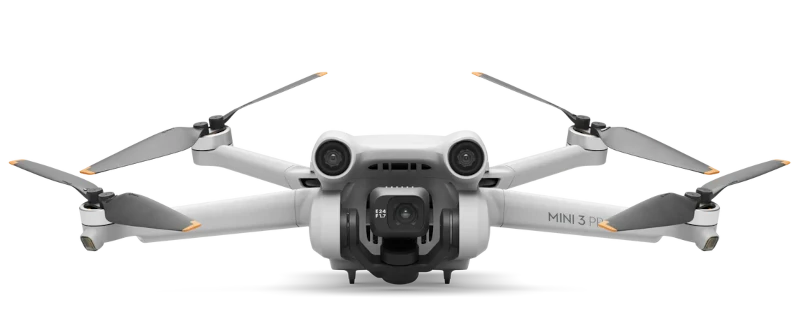
The DJI Mini 3 Pro is the drone that proved you could fit obstacle avoidance, ActiveTrack and 4K/60 fps HDR into a 249 g body. In 2026 it sits one rung below the Mini 4 Pro but remains a strong buy whenever it is discounted, ideal for solo travel creators who film themselves and want crash protection without losing the sub-250g regulatory edge.
The DJI Mini 3 Pro was the first sub-250 g DJI drone to add genuine obstacle sensing, ActiveTrack 4.0 and a long-range OcuSync 3+ link, and it remains one of the most influential mini drones on the market. The redesigned airframe pushed the gimbal forward and gave the camera a true rotating mount for 9:16 vertical clips, while keeping take-off weight under the 250 g threshold that matters most for hobbyists. Three years on it is still a serious tool for solo creators and lone Part-107 operators who want light kit, smart autonomy and real safety nets in a single airframe.
The Mini 3 Pro pairs a 1/1.3-inch CMOS sensor with a fast f/1.7 lens. Stills are 12 MP standard or 48 MP in high-resolution mode, and video runs at up to 4K/60 fps with HDR support and a flat colour profile (D-Cinelike) for editors who want more grading headroom. The gimbal can rotate 90 degrees for native 9:16 vertical capture, no software cropping needed, which makes the Mini 3 Pro one of the best mini drones for vertical short-form content. Low-light performance is competent for the size class and noticeably better than 1/2.3-inch competitors.
Flight time is rated at up to 34 minutes per standard battery in optimal conditions, with the optional Intelligent Flight Battery Plus extending that to about 47 minutes (at the cost of pushing weight above 250 g). Top speed in Sport mode is 16 m/s and wind resistance sits at Beaufort Level 5 (about 10.7 m/s). OcuSync 3+ keeps the 1080p live feed clean out to 8 km in clear conditions, with markedly better penetration through trees and urban environments than older OcuSync 2.0 transmissions on the Mini 2 SE class.
The Mini 3 Pro carries tri-directional obstacle sensing (forward, backward and downward) paired with APAS 4.0, which automatically reroutes the airframe around obstacles. ActiveTrack 4.0, FocusTrack, MasterShots, Hyperlapse and the full QuickShots set are all included. Safety extras include automatic Return-to-Home on signal loss or low battery, AirSense (ADS-B) traffic alerts and DJI's standard geofencing. Lateral and upward sensors are not present, the Mini 4 Pro added those, so be cautious in tight forest and urban side-canyon flying.
The Mini 4 Pro is the natural successor and the obvious upgrade if you can stretch the budget:
If you fly in cluttered environments or use ActiveTrack heavily, the Mini 4 Pro is worth the upgrade. Otherwise the Mini 3 Pro remains a smart pick. See our full DJI Mini 4 Pro review for the deeper comparison.
In the United States, the Mini 3 Pro qualifies for the under-250 g recreational exemption at 249 g with the standard battery, so hobby flyers do not have to register the airframe with the FAA. Swap in the Intelligent Flight Battery Plus and the take-off weight rises above 250 g, requiring registration. Commercial pilots flying under Part 107 still need a Remote Pilot Certificate regardless of weight, and Remote ID broadcasting is required for most outdoor flights. Older Mini 3 Pro units shipped without built-in Remote ID and need an external broadcast module to comply, check your firmware status before flying outdoors.
The Mini 3 Pro is the right pick for solo travel creators who film themselves with ActiveTrack, second-time pilots upgrading from a Mini 2 SE who want crash protection, and Part-107 freelancers who need a sub-250 g backup body. It is also a strong choice for parents flying with kids in moderately tight environments where obstacle sensing buys peace of mind. It is not the best pick for omnidirectional autonomy in dense forest (look at the Mini 4 Pro) or for budget-first buyers who do not need the smart features (the Mini 3 saves several hundred dollars).
The DJI Mini 3 Pro remains a benchmark sub-250 g drone in 2026 and is one of the easiest mini-drone recommendations whenever it sits below the Mini 4 Pro at retail. The combination of 4K/60 fps HDR, obstacle sensing, ActiveTrack and a long-range OcuSync 3+ link is still rare in this size class. If you can find it discounted versus the Mini 4 Pro, the savings will buy a stack of batteries and ND filters with money to spare.
For purely recreational flight no FAA registration is required as long as take-off weight stays under 250 g, which the Mini 3 Pro does at 249 g with the standard battery. The optional Intelligent Flight Battery Plus pushes weight above 250 g and requires registration.
DJI rates the Mini 3 Pro at up to 34 minutes per standard battery in optimal conditions. With the Intelligent Flight Battery Plus, rated time grows to about 47 minutes but you lose the sub-250g classification.
The Mini 4 Pro upgrades to omnidirectional obstacle sensing, ActiveTrack 360 and OcuSync 4 with longer range. The Mini 3 Pro is still excellent value if you can find it discounted, especially for travel creators who already shoot in open environments.
DJI rates the Mini 3 Pro for Level 5 winds (about 10.7 m/s). The redesigned airframe with larger propellers gives it noticeably better wind handling than the Mini 2 SE class, but caution is still advised in coastal or alpine conditions.
Yes, the Mini 3 Pro features tri-directional obstacle sensing (forward, backward and downward) paired with APAS 4.0 for automatic re-routing. Lateral and upward obstacles are not detected, so be mindful when flying in tight environments.
Pricing typically runs from around USD 759 for the standard kit (drone-only with the DJI RC-N1 controller) up to about USD 870 for the bundle with the smart DJI RC controller and Fly More Combo accessories.
| Name | DJI Mini 3 Pro |
| Gimbal | 3-axis |
| Image Sensor | 1/1.3-inch CMOS |
| FOV | 82.1° |
| Effective Pixels | 48 MP |
| Equivalent Focal Length | 24 mm |
| Aperture | f/1.7 |
| Video Resolution | 4K/60fps |
 | |
| Sensor size | 1/1.3-inch (9.98 x 7.5 mm) |
| Live-Feed | 1080p/30fps |
| ISO Range | 100 to 6400 |
| Weight | 249g / 8.8oz |
| Width | 245mm / 9.6-inch |
| Release date | 2022-05-01 |
| Drone Price | USD 759 to 870 |
| Battery | 2453 mAh |
| Max Transmission Distance | 8.0 km (4.97 mi) |
| Wind Speed Resistance | Level 5 |
| Flight Time | 34 min. |
| Max Speed | 16 m/s |
| GNSS | GPS, BeiDou, Galileo |
| Features | Hyperlapse, Follow-Me, Obstacle detection |