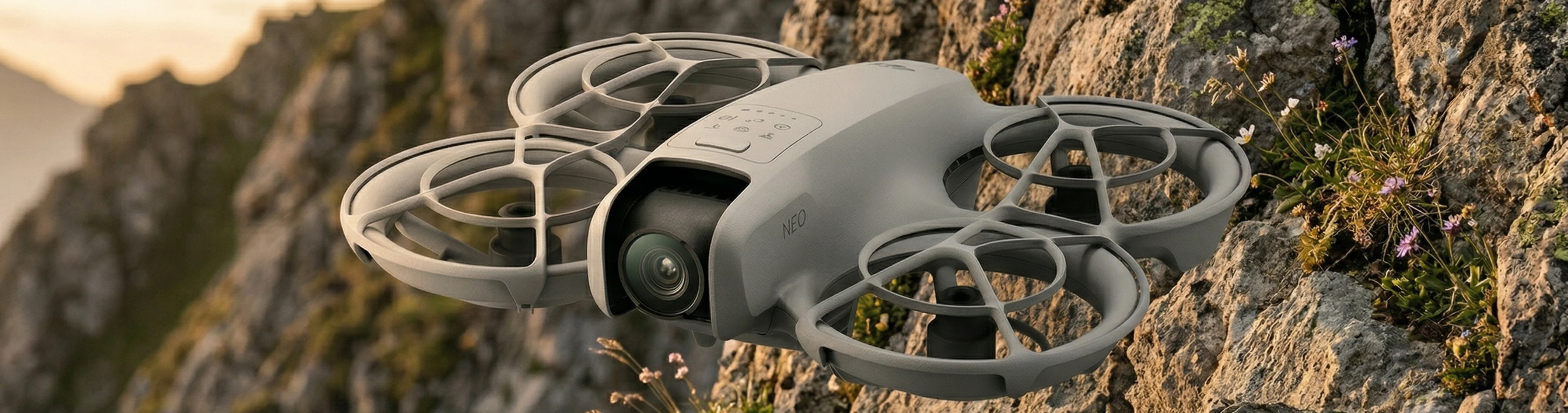
At just 135 g with a propeller cage, voice and gesture control, and 4K/30 fps capture, the DJI Neo is the easiest way to get pro-looking aerial selfies without learning to fly. It will not replace a Mini 4 Pro for serious creators, but for vloggers, beginners, and anyone who wants throw-and-catch FPV-style follow shots at the lowest possible price, it is hard to beat.
The DJI Neo redefines what an entry-level drone looks like. Instead of a folding airframe with a remote, it ships as a tiny 135 g aircraft surrounded by a full propeller guard, designed to launch directly from your palm and return to your hand at the end of the flight. That single design choice removes most of the friction that keeps people from buying their first drone: there is no take-off site to find, no controller pairing, and no fear of slicing fingers. Combined with voice and gesture control, the Neo feels much closer to a flying GoPro than to a traditional photography drone, and that is exactly the point.
The Neo carries a 1/2-inch CMOS sensor with an f/2.8 lens and a 14 mm equivalent focal length, paired with a wide 117.6 degree field of view that captures expansive selfie framing without distortion at the edges. Video tops out at 4K at 30 fps with single-axis mechanical stabilisation backed by EIS, and stills come in at 12 MP. Image quality is clearly a step below the Mini 4 Pro and Mini 5 Pro, but it is more than enough for Instagram, TikTok and YouTube Shorts where viewers watch on a phone. The wide lens also makes the Neo a strong choice for vlog-style follow shots where you want yourself plus your surroundings in frame.
DJI rates the Neo for 18 minutes of flight per battery, which works out to around 14 to 16 minutes once you account for breeze and active subject tracking. Top speed is 16 m/s and wind resistance is rated at Beaufort level 4, so the Neo handles a calm beach or open park with confidence but should be kept on the ground in coastal gusts or alpine conditions. Transmission reaches up to 7 km (4.35 mi) when paired with a controller, far more than most pilots will ever use given the small airframe and short battery.
The Neo is built around automation. Pre-programmed QuickShot routines (Dronie, Helix, Rocket, Circle, Boomerang, Spotlight) let you tap one button and capture a finished social-media clip with zero piloting skill. AI subject tracking keeps you in frame for follow shots, voice commands trigger take-off and landing, and the built-in propeller cage makes it safe to launch from your palm. GNSS uses GPS, BeiDou and Galileo for accurate positioning and Return-to-Home, and Remote ID broadcasts out of the box where required.
The Neo and the Mini 4 Pro target very different buyers. Use this quick comparison to decide which fits your needs:
The Neo wins on price, weight, and ease of use. The DJI Mini 4 Pro wins on camera quality, flight time, and serious aerial work.
In the United States the DJI Neo qualifies for the under-250 g recreational exemption (it is only 135 g), so hobby flyers do not need to register the airframe with the FAA. Commercial pilots flying under Part 107 still need a Remote Pilot Certificate regardless of weight, and Remote ID broadcasting applies to all flights. The Neo broadcasts Remote ID natively, so no external module is needed. EU pilots can typically operate it in the A1 sub-category, subject to local registration rules.
The DJI Neo is the right pick for absolute beginners who want their first aerial footage with zero learning curve, vloggers and TikTok creators who need automated follow shots, parents and families who want a safe drone to fly indoors near kids, and travel content creators who want a drone they can throw in a jacket pocket. It is not the right buy for anyone who needs cinematic 4K/60 footage, low-light performance, or the ability to fly in coastal wind, those buyers should step up to the Mini 4 Pro or Mini 5 Pro.
The DJI Neo is the most accessible camera drone DJI has ever shipped. By stripping away the controller, the gimbal complexity, and the registration paperwork, it makes aerial video genuinely fun for first-time buyers. At USD 199 it is also nearly impossible to argue with on price. If you have ever wanted aerial selfies but found other drones too expensive or intimidating, the Neo removes every excuse.
For purely recreational flight, FAA registration is not required because the DJI Neo weighs only 135 g, well under the 250 g threshold. Commercial use under FAA Part 107 still requires a Remote Pilot Certificate, and Remote ID broadcasting rules apply to all aircraft regardless of weight.
Yes, the Neo is designed for palm launch and can fly autonomously using preset QuickShot modes, voice commands, or smartphone app control. A standard remote controller and DJI goggles are also supported for pilots who want manual flight.
DJI rates the Neo at about 18 minutes per battery in optimal conditions. In real-world use with breezes and active subject tracking, plan for roughly 14 to 16 minutes of usable flight time.
The Neo records 4K video at 30 frames per second through its 1/2-inch CMOS sensor with f/2.8 lens, and shoots 12 MP stills. A single-axis gimbal plus EIS keeps footage stable for casual social media and travel content.
The Neo uses a propeller guard cage rather than full omnidirectional sensors, which makes it safe to launch and catch from your hand. It does not have the side and rear obstacle sensing found on the Mini 4 Pro or Mini 5 Pro.
Pricing starts at around USD 199 for the standalone aircraft and rises to about USD 418 for combos with a remote, goggles, or extra batteries. That makes it one of the cheapest entry points into the DJI ecosystem.
| Name | DJI NEO |
| Gimbal | 1-axis EIS |
| Image Sensor | 1/2-inch CMOS |
| FOV | 117.6° |
| Effective Pixels | 12 MP |
| Equivalent Focal Length | 14 mm |
| Aperture | f/2.8 |
| Video Resolution | 4K/30fps |
 | |
| Sensor size | 1/2-inch (6.4 × 4.8 mm) |
| ISO Range | 100 ~ 6400 |
| Weight | 135g / 4.8oz |
| Width | 130mm / 5.1-inch |
| Release date | 2024-09-01 |
| Drone Price | USD 199 to 418 |
| Battery | 1435 mAh |
| Max Transmission Distance | 7.0 km (4.35 mi) |
| Wind Speed Resistance | Level 4 |
| Flight Time | 18 min. |
| Max Speed | 16 m/s |
| GNSS | GPS, BeiDou, Galileo |
| Features | Follow-Me |

