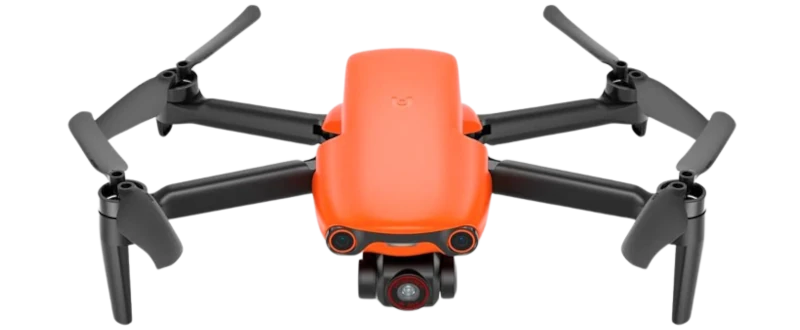
The Autel EVO Nano+ is the best Autel sub-250g drone for image quality. Same 249 g airframe, same 17 km transmission link and 28-minute flight time as the standard Nano, but with a meaningfully larger 1/1.28-inch CMOS sensor and a bright f/1.9 lens. For travellers who want clean low-light shots without stepping outside the registration-free weight class, it is the model to pick.
The Autel EVO Nano+ takes the same proven 249 g airframe as the standard EVO Nano and pushes the imaging hardware up a tier. The headline change is a much larger 1/1.28-inch CMOS sensor (paired with a bright f/1.9 fixed aperture), which puts it in the same conversation as the DJI Mini 3 Pro for low-light capability. By keeping the take-off weight at 249 g, Autel preserves the FAA recreational exemption that makes mini drones so attractive for US travel pilots. For creators who shoot at sunrise, sunset or in mixed coastal light, the Nano+ delivers cleaner footage than any other sub-250g Autel.
The 1/1.28-inch CMOS sensor (about 10 by 7.5 mm) is roughly 2.4 times larger than the 1/2-inch chip in the standard Nano, which translates into noticeably cleaner shadows and better dynamic range in tricky light. A bright f/1.9 fixed aperture pulls in more light per frame, so ISO can stay lower at sunset. Stills come in at 50 MP, video tops out at 4K at 30 fps with FullHD at 60 fps for smoother panning, and the live feed runs at 2.7K at 30 fps for an unusually crisp control-screen view. The 3-axis mechanical gimbal handles stabilisation across the board.
Flight performance mirrors the standard Nano. Autel rates the Nano+ at 28 minutes per battery, equivalent to about 22 to 25 usable minutes once breeze and active flight modes are factored in. Top speed is 15 m/s and wind resistance is rated at Beaufort level 5 (~10.7 m/s). The 17 km (10.56 mi) transmission link remains one of the longest in the sub-250g class on paper, which gives confidence on coastal and open-park missions.
The EVO Nano+ carries the same multi-directional obstacle sensors and GNSS suite (GPS, GLONASS, Galileo) as the standard Nano. Intelligent flight modes include subject tracking, hyperlapse, panorama and a library of one-tap automated routines. The orange airframe is deliberately bright for line-of-sight visibility, propellers fold neatly for travel, and the controller pairs over Autel's SkyLink transmission system.
The Mini 4 Pro is the obvious DJI alternative at this price point. Quick comparison:
If you mostly shoot stills and 4K/30 cinematic clips, the Nano+ is competitive at a slightly lower price. If you need 4K slow-motion or full 360-degree obstacle safety, step up to the DJI Mini 4 Pro.
In the United States the Autel EVO Nano+ qualifies for the under-250 g recreational exemption (it weighs exactly 249 g), so hobby flyers do not need to register the airframe with the FAA. Commercial pilots flying under Part 107 still need a Remote Pilot Certificate regardless of weight, and Remote ID broadcasting applies to all flights. Confirm that your firmware supports native Remote ID broadcast or that you are flying with an external module where required. EU pilots can typically operate it in the A1 sub-category.
The Autel EVO Nano+ is the right pick for travel creators who shoot in mixed light, real-estate freelancers who need 50 MP stills for listings, and pilots who want a sub-250g drone outside the DJI ecosystem with the best Autel image quality at this size. Anyone who needs 4K/60 or higher frame rates, omnidirectional safety or the absolute latest sensor should look at the DJI Mini 5 Pro instead.
The Autel EVO Nano+ remains the strongest sub-250g Autel for image quality. Its larger sensor and faster lens deliver clean low-light footage, and the 17 km transmission link plus bright airframe make it a very practical travel drone. It does not match the latest DJI Mini 5 Pro on outright capability, but its independent ecosystem, longer range, and competitive pricing keep it a credible recommendation in 2026.
For purely recreational flight no FAA registration is required as long as take-off weight stays under 250 g, which the Autel EVO Nano+ does at exactly 249 g. Commercial pilots flying under FAA Part 107 still need a Remote Pilot Certificate, and Remote ID broadcasting applies regardless of weight.
Both models share the same 249 g airframe, 3-axis gimbal, 17 km transmission, and 28-minute flight time. The Nano+ upgrades the sensor to a larger 1/1.28-inch CMOS with a brighter f/1.9 lens and 50 MP stills, delivering meaningfully cleaner low-light footage than the standard Nano.
Autel rates the EVO Nano+ at 28 minutes per battery in optimal conditions. In real-world use with breeze and active obstacle sensing, plan for 22 to 25 minutes of usable flight.
The Mini 4 Pro has the more modern feature set, including 4K/100 fps video and omnidirectional obstacle sensing. The Nano+ counters with a longer 17 km transmission link, brighter f/1.9 lens, and pricing that often comes in below the Mini 4 Pro at sales.
Yes, the EVO Nano+ uses multi-directional obstacle sensors paired with subject tracking, hyperlapse and panorama modes. It does not provide the omnidirectional 360-degree coverage seen on the latest DJI Mini 5 Pro.
Pricing typically runs from USD 679 to USD 799 depending on the bundle. Premium bundles include extra batteries, ND filters and a charging hub.
| Name | AUTEL EVO Nano+ |
| Gimbal | 3-axis |
| Image Sensor | 1/1.28-inch CMOS |
| FOV | 85° |
| Effective Pixels | 50 MP |
| Equivalent Focal Length | 23 mm |
| Aperture | f 1.9 |
| Video Resolution | 4K/30fps FullHD/60fps |
 | |
| Sensor size | 1/1.28-inch (10 × 7.5 mm) |
| Live-Feed | 2.7K/30fps |
| ISO Range | 100 ~ 6400 |
| Weight | 249g / 8.8oz |
| Width | 210mm / 8.3-inch |
| Drone Price | USD 679 to 799 |
| Battery | 2250 mAh |
| Max Transmission Distance | 17.0 km (10.56 mi) |
| Wind Speed Resistance | Level 5 |
| Flight Time | 28 min. |
| Max Speed | 15 m/s |
| GNSS | GPS, GLONASS, Galileo |
| Features | Hyperlapse, Follow-Me, Obstacle detection |