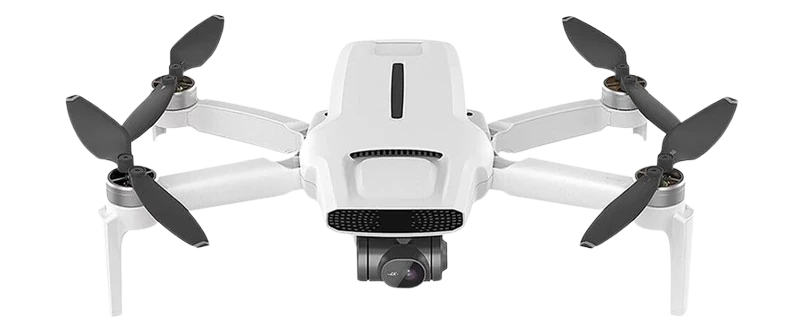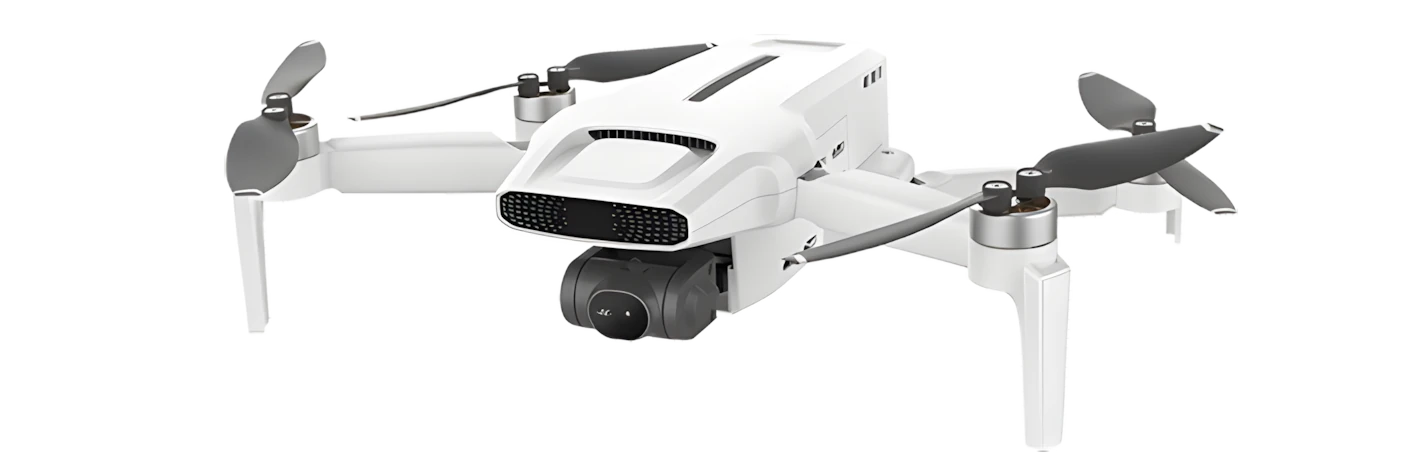
The FIMI X8 Mini V2 puts a 1/2.5-inch 12 MP sensor, 4K/30 fps video, a 3-axis gimbal and a class-leading 34-minute battery into a 245 g airframe. It is the FIMI to pick when battery life on long hikes and travel days matters more than slow-motion or 48 MP stills, and undercuts equivalent DJI Mini kit on price.
The X8 Mini V2 is FIMI's long-haul sub-250 g airframe. By holding take-off weight at 245 g, it qualifies for the FAA recreational sub-250 g exemption in the United States and the A1 sub-category in Europe, while the 34-minute rated flight time is among the longest in the class. For travel creators who shoot in long, single sit-down sessions (sunrise hikes, golden-hour real-estate scouting, multi-shot drone-footage compilations), the extra battery margin over the standard FIMI Mini 3 is meaningful.
The X8 Mini V2 uses a 1/2.5-inch CMOS sensor at 12 MP behind an f/2.0 lens with a 26 mm equivalent focal length and an 81-degree field of view. Video records at 4K/30fps, with 12 MP stills. ISO range tops out at 3200, so the sensor is happiest in good light. Stabilisation comes from a real 3-axis mechanical gimbal, which keeps shots smooth even when the airframe is being pushed around in moderate wind. It will not match the 4K/60fps capture or 48 MP detail of the newer Mini 3, but the cleaner 26 mm framing is closer to a traditional travel-photo perspective.
Flight time is rated at up to 34 minutes per battery, with 26 to 29 useful minutes likely in real-world flying. Top speed sits at 16 m/s and wind resistance is rated to Beaufort Level 5 (around 8 to 10 m/s). The 9.0 km (5.59 mi) transmission link is the same long-range FIMI link used on the Mini 3 and is comfortable headroom for any legal visual line-of-sight flight in the US or EU.
Smart shooting modes cover QuickShots, hyperlapse, panoramas, waypoints and Follow-Me subject tracking, all controlled via the FIMI Navi app. GNSS uses GPS, GLONASS, BeiDou and Galileo for fast lock and Return-to-Home. Like other FIMI sub-250 g drones, the X8 Mini V2 only has downward sensors for take-off and landing, so plan automated tracking shots in airspace clear of trees and structures.
The three obvious cross-shops:
If you mostly shoot in good daylight and want the longest FIMI battery, the X8 Mini V2 is the right call. If image quality matters more than 2 extra flight minutes, jump to the standard FIMI Mini 3 for the larger sensor and 48 MP stills. If you can stretch the budget, the DJI Mini 3 still wins on app stability and dynamic range.
In the United States the X8 Mini V2 qualifies for the under-250 g recreational exemption, so hobby flyers do not need to register the airframe with the FAA (TRUST test still applies). Commercial pilots flying under FAA Part 107 need a Remote Pilot Certificate regardless of weight, and Remote ID broadcasting is required for all flights. EU pilots can typically operate the X8 Mini V2 in the A1 sub-category subject to local operator registration.
The X8 Mini V2 is the right pick for travel creators who prize battery life over headline image quality, hobbyists who want the longest possible single-pack hike-and-fly window, and beginners who want a 3-axis gimbal sub-250 g without paying DJI prices. It is not the right pick if you need 4K/60fps slow-motion, 48 MP stills or active obstacle avoidance.
For around USD 299, the FIMI X8 Mini V2 is one of the longest-flying sub-250 g 4K drones on the market and a strong value pick for travel content creators. The image quality ceiling is below the standard FIMI Mini 3, but the longer battery and clean 26 mm framing make it the better choice for shooters whose workflow is built around uptime rather than slow-motion or pixel count.
For purely recreational flight no FAA registration is required as long as take-off weight stays under 250 g, which the X8 Mini V2 does at 245 g. Commercial use under FAA Part 107 and Remote ID broadcasting still apply, regardless of weight.
FIMI rates the X8 Mini V2 at up to 34 minutes per battery in optimal conditions. In real-world flying with wind and active filming, plan on 26 to 29 useful minutes per pack.
The X8 Mini V2 prioritises flight time (34 min) and a slightly tighter 26 mm field of view, with a 1/2.5-inch 12 MP sensor. The Mini 3 uses a larger 1/2-inch 48 MP sensor with f/1.6 aperture and 4K/60fps capture, but a slightly shorter 32-minute battery.
FIMI rates the X8 Mini V2 for Beaufort Level 5 winds (around 8 to 10 m/s). At 245 g it is still light, so coastal flying demands close attention to forecasts and battery margin for the trip home.
The X8 Mini V2 uses downward visual and ultrasonic sensing for safe take-off and landing, but does not have multi-directional obstacle sensors. Plan automated tracking shots in obstacle-free airspace.
Street pricing typically runs from about USD 299 for the standard kit up to USD 350 for combo bundles. Sale pricing on Amazon and AliExpress can drop the airframe well below USD 280.
| Name | FIMI X8 Mini V2 |
| Gimbal | 3-axis |
| Image Sensor | 1/2.5-inch CMOS |
| FOV | 81.1° |
| Effective Pixels | 12 MP |
| Equivalent Focal Length | 26 mm |
| Aperture | f2.0 |
| Video Resolution | 4K/30fps |
 | |
| Sensor size | 1/2.5-inch (5.76 × 4.29 mm) |
| ISO Range | 100 to 3200 |
| Weight | 245g / 8.6oz |
| Width | 200mm / 7.9-inch |
| Release date | 2023-05-01 |
| Drone Price | USD 299 to 350 |
| Battery | 2200 mAh |
| Max Transmission Distance | 9.0 km (5.59 mi) |
| Wind Speed Resistance | Level 5 |
| Flight Time | 34 min. |
| Max Speed | 16 m/s |
| GNSS | GPS, GLONASS, BeiDou, Galileo |
| Features | Waypoints, Hyperlapse, Follow-Me |