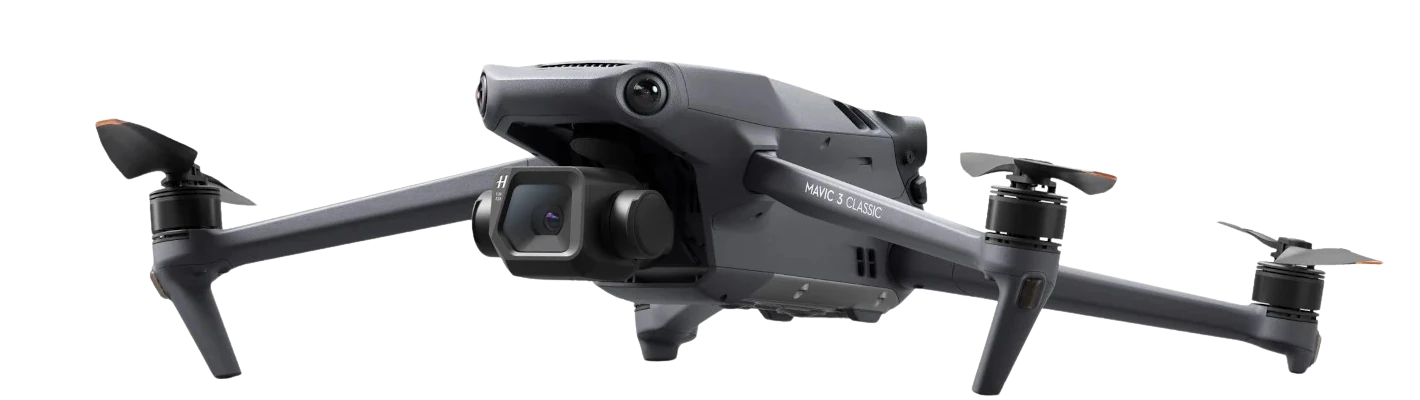
The DJI Mavic 3 Classic strips the 162mm telephoto out of the standard Mavic 3 to bring the price down, while keeping the same Hasselblad 4/3-inch CMOS wide camera, 5.1K/50 fps video, 46-minute flight time and omnidirectional sensing. For aerial photographers who care about sensor size more than reach, it remains the most affordable way into a true 4/3-inch drone in 2026.
The Mavic 3 Classic answers a simple question: what if you only need the Hasselblad camera? DJI took the existing Mavic 3 platform, removed the 162mm telephoto module from the gimbal, and dropped the launch price by hundreds of dollars. Everything else is unchanged: the same 895 g airframe, the same flight controller, the same omnidirectional obstacle sensors, the same OcuSync 3+ link and the same 46-minute flight time. For aerial photographers who do not work in inspection or surveillance and who never asked for that small-sensor tele, the Classic delivers identical headline image quality at meaningfully lower cost.
The 4/3-inch Hasselblad wide camera shoots 20 MP stills and 5.1K video at up to 50 fps with full 10-bit D-Log support and the Hasselblad Natural Colour Solution that defines the look of the entire Mavic 3 line. The variable aperture (f/2.8 to f/11) lets you stop down for sharp landscape detail or open up for cleaner low-light frames without rebuilding ND stacks. In practice, image quality coming off this camera is indistinguishable from the standard Mavic 3 wide, since it is the same sensor and same optics. If you mostly shoot landscapes, real estate, tourism or wedding aerials, this is one of the best small drones you can buy at this price level.
Flight time is rated at up to 46 minutes per battery in optimal hover conditions; expect 35 to 38 minutes per pack with realistic wind, recording and obstacle sensing. The 895 g airframe handles winds up to about 12 m/s (Beaufort 6), making it usable for most coastal and ridge-line work. OcuSync 3+ gives a stable 15 km link in FCC regions and shrugs off urban interference well. Compared to the standard Mavic 3, performance numbers are identical because the airframe is identical.
The Classic carries the same omnidirectional obstacle sensing as the Mavic 3 (forward, backward, lateral, upward and downward) with APAS 5.0 path planning, ActiveTrack 5.0 subject following, MasterShots and waypoint flights. Advanced RTH plans the most efficient return path, and Remote ID broadcasts natively for U.S. compliance. GNSS pulls from GPS, Galileo and BeiDou for fast, reliable lock.
The choice between the two is fully about the second focal length:
If you ever shoot inspections, surveillance or compressed cinematic shots, the standard Mavic 3 is worth the upcharge. If you only need the Hasselblad wide, the Classic is the smarter buy.
At 895 g the DJI Mavic 3 Classic is far above the 250 g recreational exemption, so all U.S. pilots must register the airframe with the FAA DroneZone before the first flight, even for hobby use. Commercial pilots flying under Part 107 additionally need a Remote Pilot Certificate. Remote ID broadcasting is mandatory for all U.S. flights and the Mavic 3 Classic transmits Remote ID natively. EU pilots typically operate the Classic in the C2 transition class and the Open A2 sub-category.
The Mavic 3 Classic is the right pick for landscape and travel photographers who want Hasselblad image quality at the lowest possible price, real-estate freelancers who only ever frame wide, and Part-107 pilots looking for a stable 46-minute platform for property tours. Beginners are usually better served by a cheaper beginner drone first; pixel-peepers who need the latest hardware should consider the Mavic 4 Pro.
The DJI Mavic 3 Classic remains the cheapest way to get a true 4/3-inch Hasselblad sensor in the air. With the same airframe, flight time and Hasselblad colour science as the standard Mavic 3, it punches well above its price point. As long as you do not specifically need the 162mm telephoto, the Classic is the smarter Mavic 3 buy.
Yes. At 895 g the Mavic 3 Classic is far above the 250 g recreational exemption, so all U.S. pilots must register the airframe with the FAA, even for hobby flights. Remote ID broadcasting is required, and commercial use needs a Part 107 Remote Pilot Certificate.
DJI specifies up to 46 minutes per battery in optimal hover conditions. Real-world flights with wind, recording and active obstacle sensing typically deliver 35 to 38 usable minutes per pack, identical to the standard Mavic 3.
The Classic keeps the same 4/3 Hasselblad wide, the same airframe and the same 46-minute flight time, but drops the 162mm telephoto. If you do not need the second focal length, the Classic delivers the same headline image quality at several hundred dollars less.
DJI rates the Mavic 3 Classic for sustained winds up to about 12 m/s (Beaufort 6). The 895 g airframe holds position confidently in coastal and alpine conditions, identical to the standard Mavic 3.
Yes, the Mavic 3 Classic ships with omnidirectional obstacle sensing (forward, backward, lateral, upward and downward) paired with APAS 5.0 routing. ActiveTrack 5.0 keeps subjects framed during automated avoidance moves.
Pricing typically runs from about USD 1,280 for the standard kit with the DJI RC-N1 controller up to roughly USD 1,750 for Fly More Combos with the DJI RC screen controller, extra batteries and a charging hub.
| Release | November 2022 |
| Weight | 895 g |
| Camera Sensor | 4/3" CMOS, 20MP |
| Video Resolution | 5.1K/50fps |
| Flight Time | 46 min |
| Max Range | 15 km (O3+) |
| Battery | 5000 mAh |
| Price (MSRP) | USD $1,280 to $1,750 |
