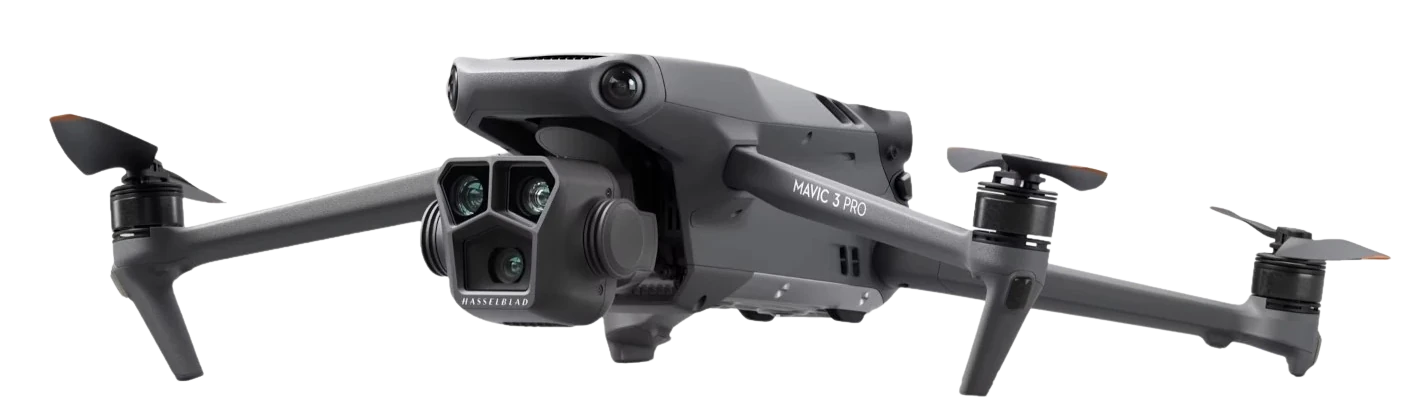
The DJI Mavic 3 Pro is the most versatile prosumer drone DJI has ever shipped, mounting a 4/3-inch Hasselblad wide, a 70mm 1/1.3-inch medium telephoto and a 166mm 1/2-inch long telephoto on a single gimbal. Combined with 5.1K/50 fps video, 43-minute flight and omnidirectional sensing, it is the right tool for working aerial cinematographers who want focal-length flexibility without two airframes.
The Mavic 3 Pro is the first DJI Mavic to ship with three cameras on the same gimbal, and that single design choice is what defines the airframe. You get a 4/3-inch Hasselblad wide for landscapes and hero footage, a 70mm 1/1.3-inch medium telephoto for the kind of compressed cinematic shots usually reserved for long-lens ground gear, and a 166mm 1/2-inch long telephoto for survey, inspection and reach-heavy real-estate work. No other folding drone in this weight class offers the same focal-length flexibility, which is why the Mavic 3 Pro is still the default pick for working aerial cinematographers in 2026, even with the newer Mavic 4 Pro on sale.
The 4/3 Hasselblad wide carries over from the Mavic 3 line: 20 MP stills, 5.1K video at up to 50 fps, 10-bit D-Log support and the Hasselblad Natural Colour Solution, with a variable f/2.8 to f/11 aperture. The 70mm 1/1.3-inch medium tele is the new headline addition, capable of 4K/60 fps with the same colour pipeline; in practice it handles around 80 percent of cinematic compression work without juggling drones. The 166mm 1/2-inch long tele tops out at 4K/30 fps and is best treated as a reach tool rather than a hero camera, but it is genuinely useful for inspection, surveillance and tight architectural details.
Flight time is rated at 43 minutes per battery, slightly less than the standard Mavic 3 because of the heavier triple-camera assembly, with realistic sessions delivering 32 to 35 usable minutes. The 958 g airframe handles winds up to about 12 m/s (Beaufort 6) and is one of the more stable folding drones in moderate gusts thanks to the heavier mass. OcuSync 3+ keeps the live feed clean out to 15 km in FCC regions; that is shorter than the newer O4+ link in the Air 3S and Mavic 4 Pro, but more than enough for the line-of-sight work most pilots actually fly.
The Mavic 3 Pro carries omnidirectional obstacle sensing (forward, backward, lateral, upward and downward) paired with APAS 5.0 path planning, ActiveTrack 5.0 subject following, MasterShots, Hyperlapse and waypoint flights. Advanced RTH plans the most efficient return path even if the controller link drops. Remote ID broadcasts natively for U.S. compliance, and the optional Cine variant adds an internal 1 TB SSD plus Apple ProRes recording on the wide camera.
The Mavic 4 Pro is the obvious upgrade path, but the comparison is closer than the version numbers suggest:
If budget allows and you need the latest hardware, the Mavic 4 Pro is the obvious flagship pick. If you want a triple-camera Hasselblad workflow at a lower price, the Mavic 3 Pro remains an excellent buy.
At 958 g the DJI Mavic 3 Pro is far above the 250 g recreational exemption, so all U.S. pilots must register the airframe with the FAA DroneZone before the first flight, even for hobby use. Commercial pilots flying under Part 107 additionally need a Remote Pilot Certificate. Remote ID broadcasting is mandatory for all U.S. flights and the Mavic 3 Pro transmits Remote ID natively. EU pilots typically operate the airframe in the C2 transition class and the Open A2 sub-category with the appropriate competency certificate.
The Mavic 3 Pro is the right pick for working aerial cinematographers who genuinely use multiple focal lengths, real-estate and architectural specialists who need the long tele for compressed elevation shots, and Part-107 freelancers building a multi-camera deliverable from a single airframe. Beginners are usually better served by a cheaper beginner drone first; pixel-peepers chasing the latest hardware should look at the Mavic 4 Pro.
The DJI Mavic 3 Pro is still the most versatile triple-camera prosumer drone you can buy, and even with the Mavic 4 Pro on shelves, it remains the right choice for many working creators. If multi-focal-length flexibility, Hasselblad colour science and a stable 43-minute platform matter more than the latest 100 MP sensor or the new infinity gimbal, the Mavic 3 Pro is the smarter purchase.
Yes. At 958 g the Mavic 3 Pro is far above the 250 g recreational exemption, so all U.S. pilots must register the airframe with the FAA, even for hobby flights. Remote ID broadcasting is required, and commercial use needs a Part 107 Remote Pilot Certificate.
DJI specifies up to 43 minutes per battery in optimal hover conditions, slightly less than the standard Mavic 3 because of the heavier triple-camera assembly. Real-world flights with wind and recording typically deliver 32 to 35 usable minutes.
The Mavic 4 Pro is the newer flagship with a 100 MP 4/3 Hasselblad wide, a 360-degree infinity gimbal, an O4+ link to 30 km, 51-minute flight and front-facing LiDAR. The Mavic 3 Pro remains an excellent triple-camera platform if you do not need the latest hardware and prefer the lower price point.
DJI rates the Mavic 3 Pro for sustained winds up to about 12 m/s (Beaufort 6). The 958 g airframe holds position confidently in coastal and ridge-line conditions and behaves very similarly to the standard Mavic 3.
Yes, the Mavic 3 Pro features omnidirectional obstacle sensing (forward, backward, lateral, upward and downward) paired with APAS 5.0 routing. ActiveTrack 5.0 keeps subjects framed during automated avoidance moves and waypoint flights.
Pricing typically runs from about USD 2,199 for the standard kit with the DJI RC controller up to roughly USD 3,900 for the Cine Premium combo with the DJI RC Pro, internal SSD, ProRes recording, extra batteries and ND filters.
| Release | April 2023 |
| Weight | 958 g |
| Camera Sensor | Triple camera (4/3", 1/1.3", 1/2") |
| Video Resolution | 5.1K/50fps |
| Flight Time | 43 min |
| Max Range | 15 km (O3+) |
| Battery | 5000 mAh |
| Price (MSRP) | USD $2,199 to $3,900 |
