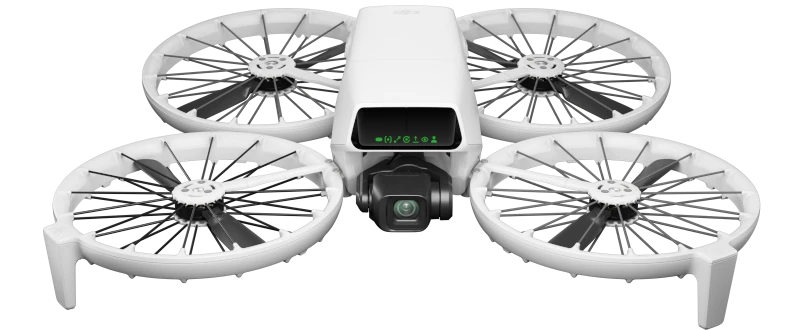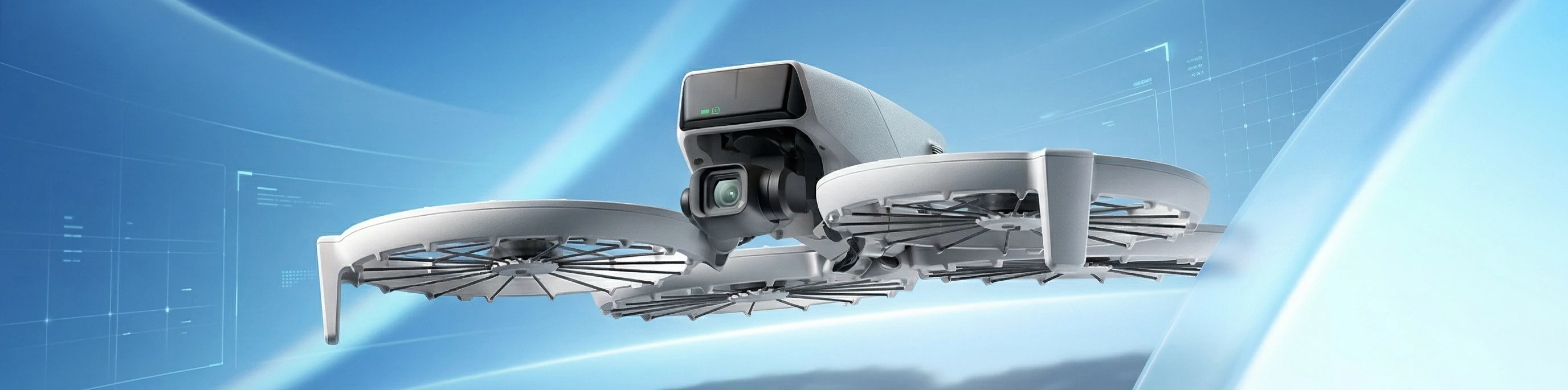
The DJI Flip is the self-flying sub-250g drone DJI's line-up was missing: palm launch, built-in propeller guards, a 1/1.3-inch sensor and 4K/100 fps slow-motion video in a 249 g body. Think of it as a Mini-class camera bolted into a Neo-style controller-free body, ideal for solo vloggers and creators who want big-drone footage without learning to pilot.
The DJI Flip exists because there was a clear gap between the controller-free DJI Neo (cheap, fun, limited camera) and the manual-flying Mini Pro line (excellent camera, requires real pilot skill). The Flip closes that gap by combining the Mini's 1/1.3-inch sensor pipeline with the Neo's palm-launch and self-flying interaction model, then wrapping the propellers in fixed guards so casual collisions do not damage the airframe or your subject. At 249 g it stays under the FAA recreational threshold, so vloggers can fly without paperwork while still getting the kind of follow shots that used to require a second crew member.
The Flip carries a 1/1.3-inch CMOS sensor with a fast f/1.7 lens, the same sensor class as the Mini 3 Pro and Mini 4 Pro. Stills are 12 MP standard or 48 MP in high-resolution mode, and video runs at 4K up to 100 fps for smooth, gradeable slow-motion that the Neo cannot match. The pipeline supports 10-bit recording and a flat colour profile, so editors get real grading headroom rather than the baked-in look common on entry-level self-flying drones. Low-light performance is competent for the size class thanks to the larger pixel pitch.
Flight time is rated at up to 31 minutes per battery in optimal conditions; in real-world use with active subject tracking and palm launches plan on 24 to 27 useful minutes. Top speed runs from 12 m/s in default modes up to 16 m/s in the more aggressive setting, slightly slower than a naked Mini because the integrated cage adds drag. Wind resistance sits at Beaufort Level 5 (about 10.7 m/s), and OcuSync transmission keeps the live feed clean out to 8 km in clear conditions when paired with a smart controller.
This is where the Flip earns its name. Out of the box it supports palm launch, a controller-free shot-template mode (Dronie, Circle, Spotlight, Trail, Boomerang), ActiveTrack subject following, MasterShots and Hyperlapse. Forward 3D infrared sensing and a downward vision system handle obstacle detection and stable hovering, and the integrated propeller cage acts as the main protection against side impacts and casual collisions, important when you are flying around your own face. Remote ID is broadcast natively, no external module required.
The Flip and Mini 4 Pro share the same sensor class but solve completely different problems:
If you want to vlog yourself with palm launch and minimal piloting, buy the Flip. If you want piloted aerial work with full omnidirectional safety, see our DJI Mini 4 Pro review instead.
In the United States, the Flip qualifies for the under-250 g recreational exemption at 249 g, so hobby flyers do not have to register the airframe with the FAA. Commercial pilots flying under Part 107 still need a Remote Pilot Certificate regardless of weight. Remote ID is broadcast natively, so no external module is required for compliant outdoor flights. EU pilots can typically operate the Flip in the A1 sub-category subject to local registration of the operator. Note that even with palm launch and a controller-free interaction model, all standard airspace, altitude and overflight rules still apply.
The Flip is the right pick for solo vloggers who want a flying selfie camera, content creators who shoot a lot of self-tracking shots and want palm launch instead of a controller, and parents or beginners who value the prop-guard safety net while they learn. It is also a sensible second body for piloted-drone owners who want a dedicated vlogging rig that is safe to launch indoors or at a small distance from people. It is not the right tool for long-range piloted aerial work or for omnidirectional autonomy in dense environments, look at the Mini 4 Pro or Mini 5 Pro instead.
The DJI Flip is one of the most original mini drones DJI has shipped in years. It takes the camera quality you expect from the Mini Pro line and bolts it into an interaction model that does not require any flying skill, and the integrated prop cage genuinely changes how comfortable you feel launching it near other people. For solo vloggers and creators who want big-drone footage without learning to pilot, this is now the easiest sub-250g recommendation in the line-up.
For purely recreational flight no FAA registration is required as long as take-off weight stays under 250 g, which the Flip does at 249 g. Commercial flights under FAA Part 107 still require registration regardless of weight, and the Flip broadcasts Remote ID natively for compliant outdoor flights.
DJI rates the Flip at up to 31 minutes per battery in optimal conditions. With moderate wind and active subject tracking, expect roughly 24 to 27 minutes of usable flight time per pack.
Yes, the Flip supports palm launch and a controller-free mode where you select an automated shot template (Dronie, Circle, Spotlight, Trail, etc.) and let the drone fly itself, much like the DJI Neo. For longer-range flights you can pair the smart DJI RC 2 controller.
DJI rates the Flip for Level 5 winds (about 10.7 m/s). The propeller guards and slightly larger 280 mm airframe give it stable handling in moderate breezes, but the integrated cage trades top speed for safety.
Yes, the Flip features forward 3D infrared sensing and a downward vision system. It does not have lateral, backward or upward obstacle sensors, the integrated propeller cage is the main protection against side impacts and casual collisions.
Pricing typically runs from around USD 439 for the standard kit (controller-free, with the DJI RC-N3) up to about USD 779 for the bundle with the smart DJI RC 2 controller and Fly More accessories.
| Name | DJI Flip |
| Gimbal | 3-axis |
| Image Sensor | 1/1.3-inch CMOS |
| FOV | 82.1° |
| Effective Pixels | 48 MP |
| Equivalent Focal Length | 24 mm |
| Aperture | f/1.7 |
| Video Resolution | 4K/100fps |
 | |
| Sensor size | 1/1.3-inch (9.98 x 7.5 mm) |
| Live-Feed | 1080p/30fps |
| ISO Range | 100 to 6400 |
| Weight | 249g / 8.8oz |
| Width | 280mm / 11-inch |
| Release date | 2025-01-01 |
| Drone Price | USD 439 to 779 |
| Battery | 3110 mAh |
| Max Transmission Distance | 8.0 km (4.97 mi) |
| Wind Speed Resistance | Level 5 |
| Flight Time | 31 min. |
| Max Speed | 12 m/s to 16 m/s |
| GNSS | GPS, BeiDou, Galileo |
| Features | Palm launch, ActiveTrack, MasterShots, Hyperlapse |