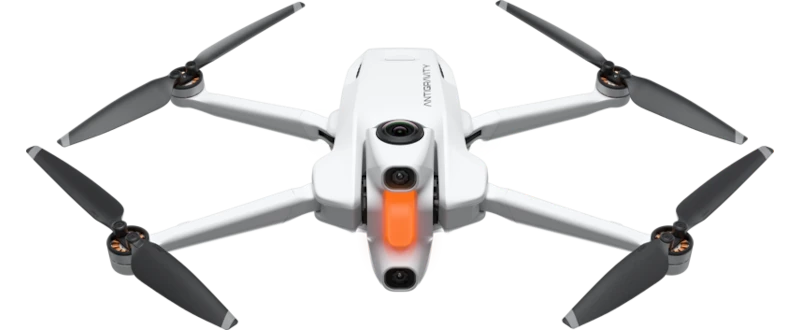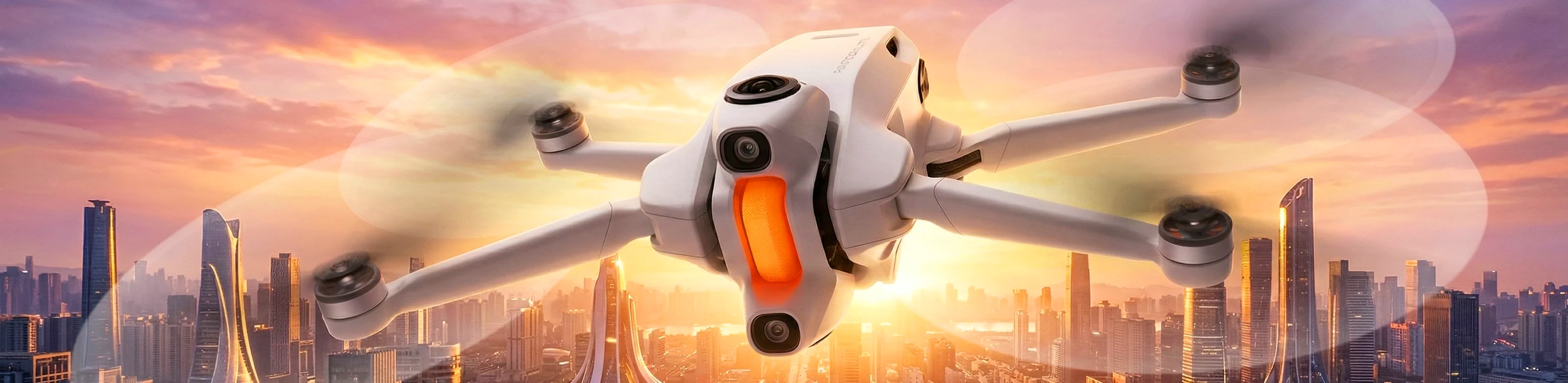
The Antigravity A1 is a genuine first: a 249 g sub-250g drone that records full 8K 360 video with two 1/1.28-inch sensors. Paired with FPV goggles and a motion grip, it abandons the traditional framing-by-stick workflow in favour of fly first, edit later. For social-first creators and 360 storytellers it is genuinely new ground; for classical aerial cinematographers it complements rather than replaces a gimballed camera drone.
The Antigravity A1 is the first ultra-light drone to combine full 8K 360 capture with a sub-250 g take-off weight, and that single fact reframes what a mini drone can be. Until now, immersive 360 capture meant either a handheld 360 camera mounted on a heavy airframe, or expensive cinema rigs. By engineering a 249 g body around two opposing 1/1.28-inch fisheye sensors, Antigravity slips this entirely new format into the regulation-friendly weight class. For pilots in the United States and most of Europe, that means no recreational FAA registration paperwork and easier travel through customs, all while capturing footage that simply cannot be replicated by a fixed-gimbal drone.
The A1 carries two 1/1.28-inch CMOS sensors, one looking up and one looking down, joined into a seamless 8K sphere at 30 fps. Stitching software hides the airframe itself, producing the so-called invisible drone effect where the camera appears to float untethered through space. Stills can be exported at up to 55 megapixels of equivalent 360 resolution, and conventional flat 4K, vertical 9:16 and square 1:1 clips are reframed in post from the same source sphere. That fly first, edit later workflow is the entire point, you set up the move, fly through the scene, then choose where the audience looks afterwards.
Flight time is rated between 24 and 39 minutes per battery, with the longer figure depending on the high-capacity pack and calm conditions. In real-world use, plan around the middle of that range. Top speed sits at roughly 16 m/s, and transmission with the supplied goggles holds up to about 10 km in optimal conditions. The airframe carries GPS, Galileo and BeiDou GNSS for stable hover and Return-to-Home, plus forward and downward obstacle sensors that keep automated moves safer in open environments.
Where most camera drones lean on a phone screen and dual sticks, the A1 ships with a pair of FPV vision goggles and a motion-based grip controller. You point the grip in the direction you want to fly, and the drone follows. For pilots who have never touched a thumbstick, the learning curve is dramatically shorter than with a Mavic-class drone. For experienced pilots, the trade-off is a less precise feel for fine inching shots, this is a creative tool first and a precision flying machine second.
The A1 supports AI subject tracking, SkyPath automated flight paths, and a library of one-tap cinematic shots. Because the entire scene is captured every frame, intelligent reframing can re-centre on the subject in post even if the original framing missed. GNSS pulls from GPS, Galileo and BeiDou for fast lock, and Return-to-Home behaves predictably in open sky.
The A1 is not a direct replacement for a DJI Mini 4 Pro or a similar gimballed mini. The decision comes down to what you want from a session:
In the United States the A1's 249 g take-off weight qualifies it for the under-250 g recreational exemption, so hobby pilots do not need to register the airframe with the FAA. Commercial pilots flying under Part 107 still need a Remote Pilot Certificate regardless of weight, and Remote ID broadcasting is required for all flights. Confirm with the manufacturer that your specific A1 ships with a compliant Remote ID broadcast module before any commercial work in US airspace. EU pilots can typically operate it in the A1 sub-category, subject to local registration rules.
The Antigravity A1 is the right pick for social-first creators making vertical reels and TikToks, action sports filmmakers who need follow-shots that stay framed automatically, and VR/360 storytellers who want true spherical aerial footage. It is not the right pick for traditional landscape or real-estate cinematographers who would be better served by a gimballed mini such as the DJI Mini 4 Pro or the larger DJI Mini 5 Pro.
The Antigravity A1 is one of the most genuinely new product categories of 2026. It will not replace a classical camera drone for everyone, but for creators willing to embrace a fly first, edit later workflow it opens shots that simply did not exist in this weight class before. As an emerging brand, software polish and ecosystem maturity still trail DJI, but the core proposition is unique enough that early adopters get something money truly cannot buy elsewhere.
The Antigravity A1 has a take-off weight of 249 g, so for purely recreational flight no FAA registration is required. Commercial use under FAA Part 107 and Remote ID broadcasting still apply, regardless of weight.
Antigravity quotes 24 to 39 minutes per battery, depending on which battery option you choose. The longer figure assumes the high-capacity pack and calm conditions, real-world mixed flying typically lands in the middle of that range.
Because the A1 records a full 360 sphere with two opposing fisheye lenses, the stitching software can hide the drone body itself from the final footage. The result looks like a free-floating camera, with no airframe visible above or below the shot.
The A1 ships with FPV vision goggles and a motion-based grip controller. You point the grip in the direction you want to fly, which is unusually intuitive for first-time pilots, but takes some adjustment for experienced thumbstick flyers.
Because every frame is a full 360 sphere, you reframe and crop in post to produce conventional flat 16:9, 9:16 or square clips. This fly first, edit later workflow is the core idea of the A1.
The A1 includes forward and downward obstacle sensing, plus GPS, Galileo and BeiDou GNSS for stable hover and Return-to-Home. It is not a fully omnidirectional system, so caution is still required around side and rear obstacles.
| Name | Antigravity A1 |
| Camera | Dual 360 lenses |
| Sensor | Dual 1/1.28" CMOS |
| Video | 8K / 30fps (360) |
 | |
| Sensor size | 1/1.28-inch (10 x 7.5 mm) |
| Photos | Up to 55MP (360) |
| Weight | 249g |
| Flight Time | 24 to 39 min |
| Max Distance | ~10 km |
| Speed | ~16 m/s |
| Obstacle Avoidance | Forward + Downward |
| Control | FPV Goggles + Motion Controller |
| GNSS | GPS, Galileo, BeiDou |
| Release | December 2025 |