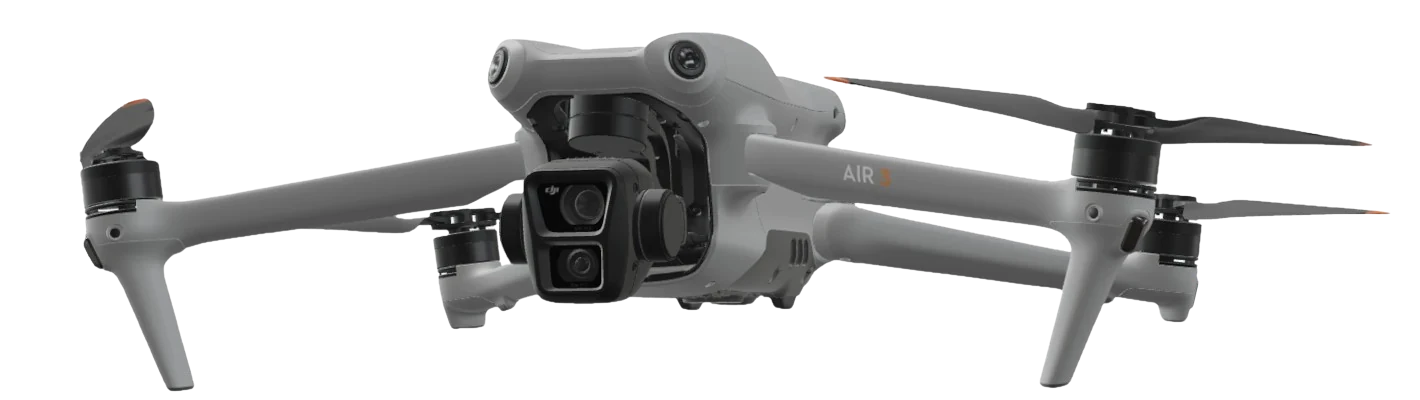
The DJI Air 3 pairs a 24mm wide and a 70mm 3x telephoto on a 720 g airframe, with 4K/100 fps HDR video, up to 46 minutes of flight time and the 20 km O4 transmission link. For creators who want a true two-lens aerial workflow without stepping up to the Mavic price bracket, it remains one of DJI's most balanced prosumer drones in 2026.
The DJI Air 3 was the first mid-range DJI drone to ship with a true dual-camera system, putting a 24mm wide-angle and a 70mm medium telephoto on the same gimbal. That combination changes how you frame aerial shots, since the 70mm tele compresses backgrounds and isolates subjects in a way the wide simply cannot. Add a 46-minute flight ceiling, OcuSync 4 transmission and a competitive entry price, and the Air 3 sits in the sweet spot between the lighter Mini class and the heavier Mavic 3 line. It is the drone we recommend most often for working creators who need range, dual focal lengths and long sessions in the air without the weight or cost of a flagship.
Both cameras use a 1/1.3-inch CMOS sensor with 48 MP stills, which keeps the image character consistent across focal lengths and simplifies grading in post. Video tops out at 4K/100 fps HDR with 10-bit D-Log M and HLG support, giving editors real headroom for colour work. In good light the wide is sharp edge-to-edge, while the 70mm telephoto unlocks tight portrait-style aerial framing and clean parallax moves around buildings, ridges or vehicles. Low-light performance is solid for a 1/1.3-inch sensor, but if you frequently shoot at dusk you will see meaningful gains by stepping up to the 1-inch wide camera in the Air 3S.
Flight time is the headline number: DJI rates the 4241 mAh pack at up to 46 minutes per charge in calm conditions. Real-world sessions with wind, recording and obstacle sensing typically deliver 35 to 38 usable minutes, still industry-leading at this weight. The 720 g airframe is rated for sustained winds around 12 m/s (Beaufort 6), which makes coastal and ridge-line shoots realistic. The OcuSync 4 (O4) link reaches up to 20 km in FCC regions and stays clean over urban environments thanks to four antennas and the new transmission codec.
The Air 3 carries omnidirectional obstacle sensing and APAS 5.0 routing for automated avoidance during ActiveTrack 360, MasterShots, QuickShots and waypoint flights. ActiveTrack 360 is a meaningful upgrade over earlier versions: the drone can now circle a moving subject while keeping it framed, which is genuinely useful for cyclists, runners and vehicles. GNSS pulls from GPS, Galileo and BeiDou, and Remote ID broadcasts natively so no external module is required for U.S. compliance.
The Air 3S, launched a year later, is the obvious upgrade path. The decision comes down to imaging budget:
If you mostly shoot in daylight and need to keep the kit affordable, the Air 3 still delivers excellent footage. If you regularly work in mixed light or need long-range cinematic projects, the Air 3S is worth the upcharge.
At 720 g the DJI Air 3 sits well above the 250 g recreational exemption, so all U.S. pilots must register the airframe with the FAA DroneZone before the first flight, even for hobby use. Commercial pilots flying under Part 107 additionally need a Remote Pilot Certificate. Remote ID broadcasting is mandatory for all flights in U.S. airspace, and the Air 3 transmits Remote ID natively, so no external module is required. EU pilots typically operate the Air 3 in the C1 transition class with appropriate Open category sub-categories, subject to local registration.
The Air 3 is the right pick for prosumer creators who want a two-lens kit without paying Mavic prices, real-estate and tourism shooters who benefit from the 70mm tele, and freelancers who value 46-minute flight blocks for long site surveys. Beginners are usually better served by a cheaper beginner-class drone first, and absolute pixel-peepers should jump straight to the Air 3S or Mavic 3 line for the larger sensors.
The DJI Air 3 remains one of the best-balanced prosumer drones DJI has shipped: dual focal lengths, 46-minute flight time, omnidirectional sensing and the modern O4 link, all at a sub-Mavic price. It has been displaced as the absolute imaging leader by the Air 3S, but for buyers prioritising range, flight time and value over sensor size, it is still the smartest dual-camera buy in 2026.
Yes. At 720 g the DJI Air 3 is well above the 250 g recreational exemption, so all U.S. pilots must register the airframe with the FAA, even for hobby flights. Remote ID broadcasting is required, and commercial use requires a Part 107 Remote Pilot Certificate.
DJI rates the Air 3 at up to 46 minutes per battery in optimal conditions. With moderate wind, video recording and active obstacle sensing, plan on roughly 35 to 38 usable minutes per pack.
The Air 3S upgrades the wide-angle camera to a 1-inch sensor, adds 14-stop dynamic range, forward LiDAR and a longer 32 km O4+ link. The Air 3 is meaningfully cheaper and shares the same 70mm telephoto and 46-minute flight class, so it remains the better-value pick if low-light imaging is not a priority.
DJI rates the Air 3 for sustained winds up to about 12 m/s (Beaufort 6). The 720 g airframe holds position confidently in coastal and alpine settings, considerably better than smaller Mini-class drones.
Yes, the Air 3 ships with omnidirectional obstacle sensing (forward, backward, lateral, upward and downward) paired with APAS 5.0 routing. Combined with ActiveTrack 360 and waypoint flight, it can plan and avoid in real time during automated shots.
Pricing typically runs from about USD 1,100 for the standard kit with the DJI RC-N2 controller up to roughly USD 1,550 for Fly More Combos with the RC 2 screen controller, extra batteries and a charging hub.
| Release | July 2023 |
| Weight | 720 g |
| Camera Sensor | Dual 1/1.3" CMOS, 48MP |
| Video Resolution | 4K/100fps HDR |
| Flight Time | 46 min |
| Max Range | 20 km (O4) |
| Battery | 4241 mAh |
| Price (MSRP) | USD $1,100 to $1,550 |
